
How to Buy Property in Dubai as a Foreign Investor

Dubai has become one of the most accessible real estate markets in the world for international buyers. There are no nationality restrictions on purchasing property, no requirement for a UAE visa or residency, and no annual property tax once you own. In 2024 alone, the Dubai Land Department recorded over 226,000 transactions worth AED 761 billion, with a significant portion executed by non-UAE nationals from India, the UK, Russia, China, Europe, and the United States.
This guide covers everything a foreign investor needs to know before buying property in Dubai — from legal ownership rights and the step-by-step purchasing process to costs, financing, visa eligibility, and the risks that most brokerage websites will not mention.
Who Can Buy Property in Dubai
Any foreign national — regardless of country of origin, age, or residency status — can purchase freehold property in Dubai in designated areas. You do not need a UAE visa, a local sponsor, or a partner. Both individuals and corporate entities can hold title deeds, and there is no limit on how many properties a foreigner can own.
This is governed by Law No. 7 of 2006 and Regulation No. 3 of 2006, which established designated freehold areas where non-UAE nationals have full ownership rights. These rights include the ability to sell, lease, inherit, and mortgage the property without restriction.
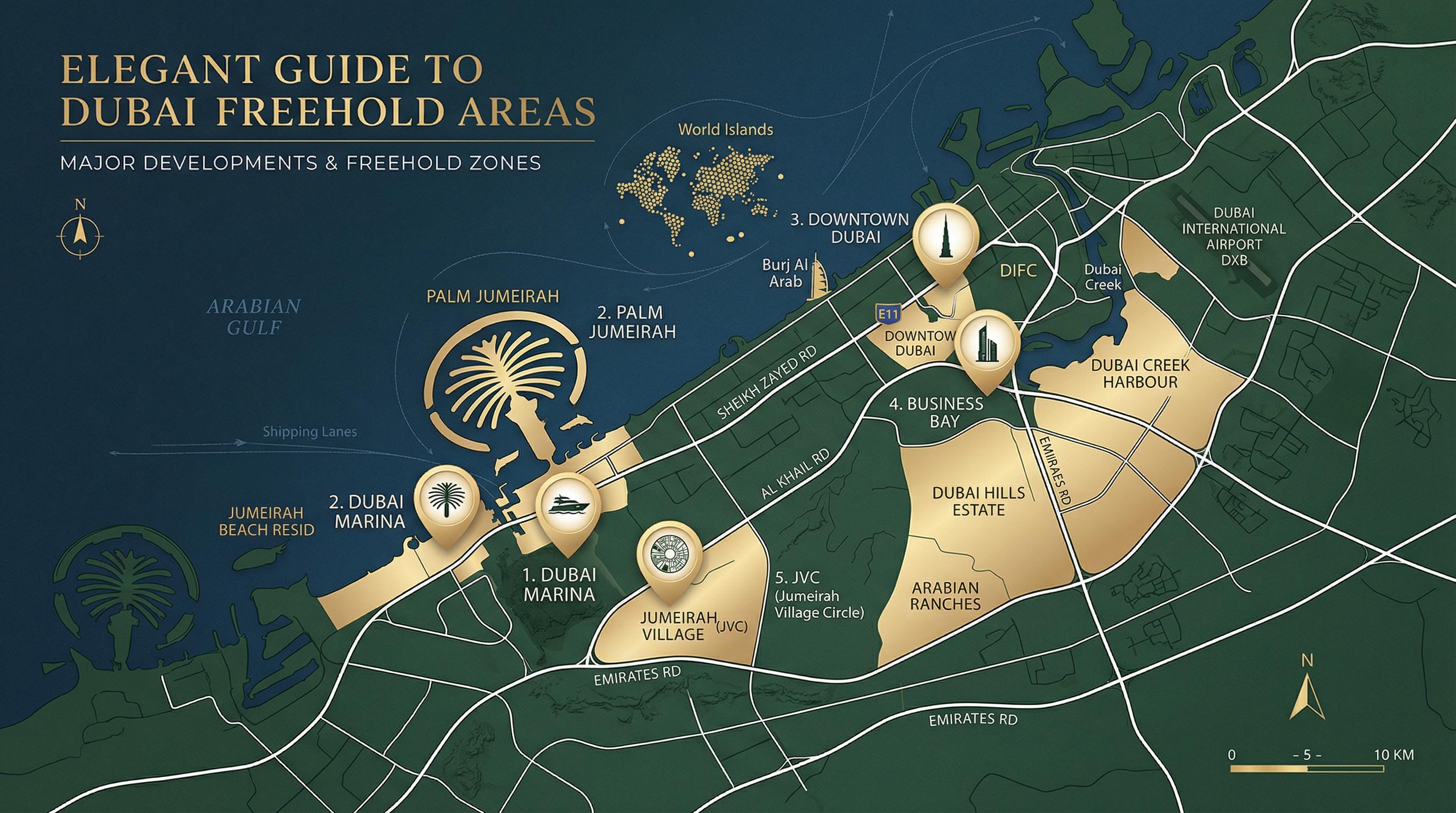
Freehold Zones: Where Foreigners Can Buy
Foreign buyers can purchase in over 40 designated freehold areas across Dubai. The most active freehold zones include:
Dubai Marina, Downtown Dubai, Palm Jumeirah, Business Bay, Jumeirah Village Circle (JVC), Dubai Hills Estate, Jumeirah Lake Towers (JLT), Arabian Ranches, Dubai Creek Harbour, DAMAC Hills, Dubai Silicon Oasis, MBR City, Emaar Beachfront, Bluewaters Island, Dubai South, International City, Al Furjan, Jumeirah Beach Residence (JBR), Dubai Sports City, and Discovery Gardens.
Each of these communities offers different price points, lifestyle profiles, and rental yield potential. Choosing the right area depends on whether you are buying for rental income, capital appreciation, personal use, or a combination.
Types of Property Available
Foreign buyers in Dubai can purchase apartments (studios through to penthouses), villas, townhouses, commercial offices, retail units, and warehouse space. Properties are available in two stages: ready (completed and available for immediate use or rental) and off-plan (under construction with payment plans spread across the build period).
Off-plan properties typically cost less per square foot than ready equivalents in the same community, and developers offer structured payment plans — commonly 70/30, 60/40, or Danube-style 1% monthly models — that allow buyers to spread payments over the construction period without requiring a bank mortgage.
Ready properties offer immediate occupancy or rental income, and buyers can finance them through UAE bank mortgages if eligible.
Step-by-Step Buying Process
Step 1: Define your investment objective. Are you buying for rental income, capital growth, personal use, or a Golden Visa? This determines the property type, location, and budget range. At RnD Realty, we start every client engagement with an investment strategy conversation — not a property listing.
Step 2: Select the right area and property. Research communities based on current pricing, rental yields, upcoming supply, developer track record, and connectivity. Our area guides on this website cover the most active investment communities with real data from DXBInteract and DLD.
Step 3: Engage a RERA-licensed broker. All real estate agents in Dubai must be registered with the Real Estate Regulatory Agency (RERA). Verify any agent's credentials through the DLD website before sharing personal or financial information. RnD Realty is a RERA-licensed brokerage registered with the Dubai Land Department.
Step 4: Make an offer and sign the agreement. For ready properties, the buyer and seller sign a Memorandum of Understanding (MOU), also known as Form F. This specifies the agreed price, terms, and completion timeline. A 10% deposit is standard at this stage. For off-plan properties, you sign a Sales and Purchase Agreement (SPA) directly with the developer and pay the booking amount (typically 10-20%).
Step 5: Obtain a No Objection Certificate (NOC). The seller requests an NOC from the developer, confirming that there are no outstanding service charges or liabilities against the property. This typically takes 3-5 working days and can be initiated through the Dubai REST app.
Step 6: Complete the transfer at DLD. Both parties attend a DLD-authorised trustee office to complete the ownership transfer. The buyer pays the DLD transfer fee (4% of the property value), the trustee fee, and any remaining balance. The new title deed is issued in the buyer's name.
For off-plan properties, registration happens through the Oqood system — the DLD's platform for properties under construction. The Oqood registration fee is approximately 4% of the property value.
Total Costs of Buying Property in Dubai
The purchase price is not the only cost. Budget for 7-9% on top of the property value for total acquisition costs. Here is the complete breakdown:
DLD Transfer Fee: 4% of the property value (this is the largest single cost). Trustee Office Fee: AED 4,000 for properties above AED 500,000, plus 5% VAT. Real Estate Agent Commission: Typically 2% of the property value, plus 5% VAT. NOC Fee: Varies by developer, typically AED 500 to AED 5,000. Mortgage Registration Fee (if applicable): 0.25% of the mortgage amount, plus AED 290. Valuation Fee (if mortgage): AED 2,500 to AED 3,500. Admin Fee: AED 580 for the DLD registration system.
For a property valued at AED 2,000,000, your total acquisition cost (including all fees and agent commission) will be approximately AED 2,160,000 to AED 2,180,000.
There is no annual property tax in Dubai. There is no capital gains tax on property sales. There is no income tax on rental earnings. The only recurring cost is the annual service charge (maintenance fees set by the Owners Association) and a 5% housing fee calculated on the average annual rental value, included in your DEWA utility bill.
Mortgage Options for Foreign Buyers
Non-resident foreign buyers can obtain mortgages from UAE banks, though the terms differ from those available to UAE residents.
For non-residents, the maximum loan-to-value (LTV) ratio is typically 50-65%, meaning you need a cash deposit of 35-50% of the property value. UAE residents can access LTV ratios of 75-80% for properties valued under AED 5 million.
Banks that actively lend to foreign buyers include Emirates NBD, HSBC UAE, First Abu Dhabi Bank (FAB), Abu Dhabi Islamic Bank, and Mashreq Bank. Requirements typically include proof of income, bank statements (6-12 months), employment verification, and a credit report from your home country.
Mortgage pre-approval should be obtained before signing the final purchase agreement. This avoids contractual penalties if financing is not secured within the agreed timeline.
Important: Off-plan properties purchased on developer payment plans do not require a mortgage during the construction phase. The mortgage only becomes relevant at handover (if needed) to finance the remaining balance.
Visa and Residency Options Through Property
Property investment in Dubai can qualify you for a UAE residence visa, though purchasing property and obtaining a visa are separate processes. Here are the current thresholds:
For properties valued at AED 750,000 or above, buyers can apply for a 2-year renewable investor residence visa through the General Directorate of Residency and Foreigners Affairs (GDRFA).
For properties valued at AED 2,000,000 or above, buyers are eligible for the 10-year Golden Visa. The property must be in a freehold zone and not mortgaged above 50% of its value. The Golden Visa extends to the investor's spouse and dependents.
The Golden Visa does not require the holder to live in the UAE full-time. There is no minimum stay requirement, making it suitable for international investors who want residency benefits without relocating.
Note: Property investment does not lead to UAE citizenship. The UAE does not offer a standard citizenship-by-investment pathway for property buyers.
Off-Plan Buying: What Foreign Investors Need to Know
Off-plan purchases in Dubai are regulated under Law No. 8 of 2007 on Escrow Accounts. All buyer payments must be deposited into DLD-supervised escrow accounts. Developers must be RERA-registered and must provide a completion guarantee before launching sales. The escrow system protects buyer funds if a developer fails to deliver the project.
Key considerations for off-plan buyers: verify the developer's track record for delivery timelines and build quality. Check whether the project has been registered with DLD. Confirm the escrow account details. Understand the payment plan structure — what percentage is due during construction, what is due on handover, and whether there are post-handover payment options.
At RnD Realty, we evaluate every off-plan project we recommend against the developer's historical delivery performance, the area's supply-demand dynamics, and the realistic rental yield potential. We do not promote projects based on developer commission rates.
Common Mistakes Foreign Buyers Make
Based on our experience advising international investors, these are the most frequent and costly mistakes:
Not verifying title deed authenticity before signing the MOU. Always confirm ownership through the DLD or Dubai REST app before transferring any funds.
Buying based on marketing materials without independent area research. Developer brochures show renders and projections — not market reality. Check DXBInteract for actual transaction data and rental rates in the area.
Ignoring service charges. Annual service charges vary dramatically by community and can significantly impact net rental yields. A community with 6% gross yield but AED 25/sqft service charges delivers very different net returns than one with AED 12/sqft.
Not budgeting for total acquisition costs. Many first-time buyers plan for the purchase price but forget the 7-9% in fees, commissions, and registration costs.
Buying off-plan from a developer with no delivery track record. New developers enter the Dubai market regularly. Some deliver well, others don't. Check DLD records for completed projects before committing capital.
The RnD Realty Approach
We are not a listing-based brokerage. We do not push volume. We are an investment advisory firm that happens to hold a brokerage license. Every property recommendation we make is backed by market data, area-level transaction analysis, and an honest assessment of both the upside potential and the risks.
Our clients are international investors from the USA, UK, Europe, India, and beyond. They choose to work with us because we give them the information they need to make confident decisions — not sales pressure.
If you are considering buying property in Dubai and want a data-driven conversation about what makes sense for your situation, contact our advisory team.
Email: contact@rndrealty.ae Office: Onyx Tower 1, Sheikh Zayed Road, The Greens, Dubai Website: rndrealty.ae
Frequently Asked Questions
Can foreigners buy property in Dubai? Yes. Any foreign national can buy freehold property in designated areas across Dubai. No visa, residency, or local sponsor is required.
How much does it cost to buy property in Dubai? Budget for 7-9% above the property price for total acquisition costs, including the 4% DLD transfer fee, agent commission, trustee fees, and administrative charges.
Do I need to visit Dubai to buy property? No. The purchase can be completed remotely using a Power of Attorney (POA) attested by the UAE Embassy in your home country or through the Ministry of Foreign Affairs (MOFA). However, we recommend visiting for high-value purchases.
Is Dubai property a good investment? Dubai offers gross rental yields of 5-8% across most active communities, zero income tax on rental earnings, and no capital gains tax. However, investment suitability depends on your financial objectives, timeline, and risk tolerance. We provide personalised analysis for every client.
What is the minimum investment for a Golden Visa? AED 2,000,000 in property qualifies for the 10-year Golden Visa. The property must be in a freehold zone and not mortgaged above 50%.
Can I get a mortgage as a non-resident? Yes. Several UAE banks offer mortgages to non-residents at 50-65% LTV. You will need proof of income, bank statements, and a credit report from your home country.